ALTA2023: The 21st Australasian Language Technology Association Workshop
- Published
- Filed under
- Academic, Technology, voice and speech technology
- Reading time
- 29 min
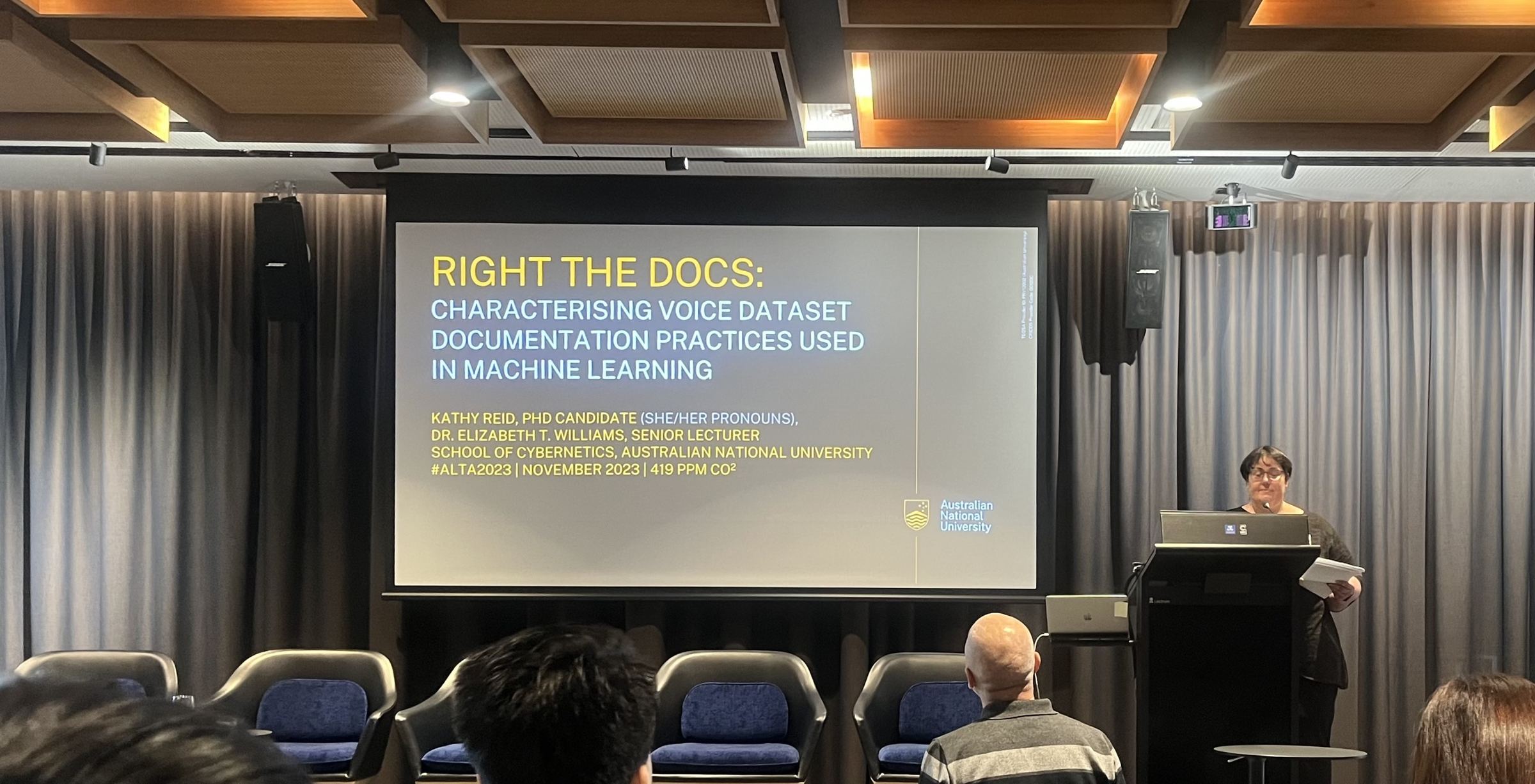
Earlier this month, I was delighted to attend the Australasian Language Technology Association (ALTA) Workshop - a key gathering of Australian natural language processing (NLP) and linguistics professionals, focusing on advancements in the field. This blog post is an abridged version of my notes from the conference.
Introduction, overview and general observations
About ALTA and the ALTA workshop
The ALTA conference is the annual workshop of the Australian Language Technology Association. Proceedings of the workshop are published in the Association for Computational Linguistics (ACL) Anthology.
According to their website:
“The purpose of the Australasian Language Technology Association is to promote language technology research and development in Australia and New Zealand. ALTA will organise regular events for the exchange of research results and for academic and industrial training, and will co-ordinate activities with other professional societies. ALTA is a founding regional organisation of the Asian Federation of Natural Language Processing.”
This was the first time I had attended ALTA, and I submitted here based on it being the key linguistics conference in Australia. There are several data science conferences, but my inter-disciplinary work crosses data, speech recognition, fairness, bias and social science: it’s hard to know where to submit. My work was definitely a little of out of place here; there were only two other speech-related papers accepted - one on cepstral features in signal processing by A/Prof Shunichi Ishihara which was veryinteresting, and one by Yishan Huang on encoding prefixes and suffixes in Southern Min - also interesting. Overall, most of the papers here had a very quantitative and computational focus, unlike say conferences like HCI or CSCW which generally present more qualitative work.
As a first-timer to the Workshop, I found the community welcoming and helpful; lots of people said hello and introduced themselves.
Acceptance rate and
academic impact factor
At the Workshop opening, the Program Chair, Jey Han Lau, advised that the acceptance rate of the conference was 68%; 25 papers were submitted and 17 were accepted. I was surprised that so few papers were submitted to this conference given that it’s the main linguistics conference in Australia, but that became clearer during the ALTA AGM when Massimo Piccardi advised that the conference’s impact rating had been demoted from “Australasian B” to “Australasian C” by CORE - the Computing Research and Education of Australasia. I had never heard of this group before, but apparently the Australian Research Council uses their rankings to assess grant applications. The primary factor contributing to the demotion was that the conference was not indexed by SCOPUS, but the ALTA Committee has addressed this and the conference is now indexed.
Looking at this from a dynamics perspective, it’s clear that rankings play a part in terms of which venues academics working on NLP submit to. This makes sense; academic time is limited, so it’s rational to submit to output targets that are highly ranked in terms of “impact factor”. I wonder, however, whether this means the ALTA workshop misses out on interesting or novel work because it’s considered low-ranked - that is, whether authors “withhold” that work for higher-ranked international conferences like EMNLP?
Venue and hybrid nature
The venue was Melbourne Connect, a purpose-built collaboration space intended to help
academia and industry forge closer connections. The venue positions itself as a “collaboration ecosystem” and the space reflects this goal; there are lots of comfortable seats, presentation spaces, smaller collaboration rooms and lecture-style facilities. Located on Swanston Street between RMIT and University of Melbourne, it was easy to access. The venue had Eduroam WiFi via the University of Melbourne, which was very useful. It was an excellent venue choice for the workshop.
The conference was “online-first” in that most of the presenters and audience was in the physical space, however Zoom was used to provide a hybrid capability for presenters who were unable to be there in person. This was generally well managed, but was often distracting for the audience as each speaker had to connect to Zoom when they were at the lectern. I feel like there has to be an easier way to create a hybrid experience.
What will I do
differently after this conference?
- All things
pytorchandpython. All of the modelling work done here was done usingpythonand more importantly,pytorch. There was a lot ofscikit-learnbeing used (I was expecting a lot morespaCy, but folks are usingscikit-learn). I am not as fluent inpytorchas I would like to be. Alternatives such askerasandTensorFlowappear to have gone by the wayside. - Think more deeply about annotation of speech data, such as transcription, because this has implications for how NLP research is conducted on text corpora.
Key themes and disciplinary directions
Large language models, and transformers in particular, dominate the field but there is a turn to “grounding” models using Retrieval Augmented Generation (RAG)
Vaswani, A., Shazeer, N., Parmar, N., Uszkoreit, J., Jones, L.,
Gomez, A.N., Kaiser, Ł. and Polosukhin, I., 2017. Attention is all you
need. Advances in neural information processing systems, 30.
Devlin, J., Chang, M.W., Lee, K. and Toutanova, K., 2018. Bert:
Pre-training of deep bidirectional transformers for language
understanding. arXiv preprint arXiv:1810.04805.
Liu, Y., Ott, M., Goyal, N., Du, J., Joshi, M., Chen, D., Levy, O.,
Lewis, M., Zettlemoyer, L. and Stoyanov, V., 2019. Roberta: A robustly
optimized bert pretraining approach. arXiv preprint
arXiv:1907.11692.
Lewis, P., Perez, E., Piktus, A., Petroni, F., Karpukhin, V., Goyal,
N., Küttler, H., Lewis, M., Yih, W.T., Rocktäschel, T. and Riedel, S.,
2020. Retrieval-augmented generation for knowledge-intensive nlp tasks.
Advances in Neural Information Processing Systems, 33
Since their advent in 2017, attention-based transformer models have re-shaped most branches of machine learning, and NLP is no exception. Many of the papers presented work which compared traditional statistical models such as alongside transformer-based NLP models such as BERT and RoBERTa. With only some minor exceptions, the transformer-based models outperformed the statistical models, especially when they were fine-tuned for a task.
Transformer models are here to stay.
Moreover, several authors used LLMs such as GPT variants to provide synthetic data for their studies - primarily to augment the sparse data sources they were working with. The competition task for the conference (which I did not participate in) also used LLMs - with the challenge being to distinguish between human-generated and LLM-generated text. There was no discussion of the biases or the material encoded by LLMs - such as them responding with more American-inflected text (e.g. “faucet” instead of “tap” or “diaper” instead of “nappy”), and what implications this has for using LLMs to generate synthetic data.
However, there appears to be a key turn in the field to “grounding” LLMs onto other forms of knowledge representation to improve their explainability and to reduce their tendency to hallucinate factually incorrect responses to prompts. The key tools being used to “ground” LLMs are knowledge graphs. They add a mechanism that allows the LLM to “reason” over the knowledge graph.
This is also known as Retrieval Augmented Generation (RAG) and this is a good blog post on it from NVIDIA.
One of the gaps I see in the LLM space is an Australian-specific LLM and knowledge graph - that can handle Australian-specific words (named entities such as place names - Geelong, Yackandandah, Canberra - which are Indigenous-derived) and maps Australian-specific knowledge - things like not spreading Vegemite too thickly on toast. As we think about metaverses, and about how content is synthetically generated (imagery, video, speech, text, dialogues) within the metaverse, having graphs to ground knowledge for “authentic” or “realistic” experiences is going to be important, particularly if the metaverse is used for training, which is a key use case.
Ensemble models: Using multiple models for better prediction
Many of the papers adopted an “ensemble” approach when building models. Essentially, ensemble learning uses multiple models, combined with some form of voting mechanism, to improve the prediction task. I hadn’t come across these in any depth previously (they’re not generally used in speech recognition) and I found this paper a very useful primer:
Sagi, O. and Rokach, L., 2018. Ensemble learning: A survey. Wiley
Interdisciplinary Reviews: Data Mining and Knowledge Discovery, 8(4),
p.e1249.
Everybody wants to do the model work, not the data work
Sambasivan, N., Kapania, S., Highfill, H., Akrong, D., Paritosh, P.
and Aroyo, L.M., 2021, May. “Everyone wants to do the model work, not
the data work”: Data Cascades in High-Stakes AI. In proceedings of the
2021 CHI Conference on Human Factors in Computing Systems
(pp. 1-15).
Nithya Sambasivan and others, in their 2021 paper, highlighted the role that data quality plays in high-stakes environments in which AI technologies are used, and how data quality can cause compounding harms for AI models. The title of this paper - “everybody wants to do the model work, not the data work” - is something I’m constantly reminded of in speech and language technologies. Several speakers highlighted the challenge of being able to obtain enough data from which to build models, which is a particular barrier to NLP in the health field - which, rightly, places strict control on patient medical records. Indeed, one speaker remarked that their model work was “really a very small part of the project” - which had involved 283 patient records being coded by two clinical practitioners to determine a taxonomy that was subsequently used for modelling. In some conferences, such as NeurIPS, there are now dedicated tracks for dataset development, which seek to recognise the impact, and elevate the prestige, of data work.
I wonder if ALTA needs a similar track, dedicated to building NLP datasets?
The need for the intersectionality of NLP and other domains
Many of the talks at the workshop focused on ‘clinical NLP’ - the application of NLP techniques to medical and healthcare settings, primarily because there is a large team at University of Melbourne working on this. The field is recognising the need to intersect with other domains due to the specialist language and language patterns that are specific to domains; this presents more opportunities for inter-disciplinary work.
There is little attention being paid to the broader market implications of LLMs and the dependencies being created
In the keynote by Terrance Szymanski, the Principal Data Scientist at SEEK, he outlined how the LLM market is working - with companies that are producers of LLMs (such as OpenAI and Anthropic), and companies that are consumers of NLP products - essentially most of the companies that don’t do a lot of in-house NLP model production. There are broader implications here that weren’t touched on - such as all of the major LLM providers being American. Sure, there are Australian companies building on top of products like GPT, but we don’t have people building LLM models in Australia. This raises questions of increasing dependence on cloud platform providers - LLMs are another form of cloud product - and a gap in our national capability.
Is this a market gap or opportunity to increase our national capability?
There is also the similar argument here of increasing dependence by academia on corporate-owned LLMs. Professor Heng Ji in her keynote called out the need for an academic-owned LLM to reduce this dependence. There are already efforts here by groups like Eleuther AI who have lots of open source LLMs, but AFAIK there is no stewardship of similar efforts for academia. This is in contrast to open models for NLP like the BERT family, which are freely available.
See also this take about how open source is the winner from the OpenAI fallout.
The need for more work on Australian English and Australian Indigenous languages
I was surprised that none of the papers focused on Australian English or Australian Indigenous languages, especially given the efforts happening around UNESCO’s Decade of Indigenous Languages. This may be because the biennial PULiiMA Indigenous Languages and Technology Conference operates in this space, and is supported by groups working on Indigenous languages like First Languages Australia and AIATSIS. Similarly, while authors frequently described the problem of not having enough data to work with, particularly medical and health data, there were no discussions of data sovereignty, of decolonising language technology or of linguistic justice.
In conversations I’ve had with institutions who are tentatively adopting machine learning-enabled technologies to aid with tasks like preservation of audio-visual material, and indexing of speech collections, the predominant models in this space tend to have poor results on Indigenous-derived words - for example, mis-transcribing “Eora Nation” as “urination”; both incorrect and highly offensive. There is still much to do in this space.
Talk highlights - Day 1 - Wednesday 28th November
Introduction to clinical NLP
Dr Mike Conway, Senior Lecturer in Digital Health
Dr Conway introduced the topic of clinical NLP, which is the application of NLP to medical and health settings. He explained that there isn’t enough intersection between health and computer science. There is huge growth in health related data, but it’s not usable - that is, it’s hard to extract information from it.
Clinical text has specific properties that make it difficult to work with using NLP tools. Some data is structured - like clinical notes, ICD-10 codes, test orders and test results, but some data is unstructured, for example a patient’s preferred name, or whether the patient has social support - e.g. “arrived with wife and daughter”; that’s an inference that can be made from the unstructured data. Many tasks in health are inefficient and NLP has many possible applications - such as real time outbreak and disease surveillance.
Clinical NLP is challenging for many linguistic reasons:
- derivation: forming a new word using a suffix or prefix such as “unrelated” from “related”
- inflection: a related word - “patients” from “patient”
- synonyms: many diseases can be expressed using similar terms, such as “adrenal insufficiency” for “Addison’s disease”
- polysemy: where one word has many meanings depending on the context - “discharge from a wound” is different to “discharging a patient”
- acronyms: vary between speciality and by geography (e.g. US abbreviations are different to Australian abbreviations)
- spelling errors: are often present in clinical notes - up to 10% of terms are mis-spelled
- negation: clinicians’ diagnostic process is often to rule things out, so negation is important. Negation can be implicit or explicit.
- uncertainty: diagnosticians are often equivocal about their diagnoses - e.g. “tentative” or “probably”. Uncertainty exists on a spectrum between certainly positive to certainly negative so it’s not a binary classification problem.
- temporality: did the patient previously have a condition or are they currently presenting with symptoms or the condition?
- discourse structure: clinical notes often follow an anatomical location of the body, but some sections have more weight
- co-reference: when is a nodule a tumour?
Clinical data is difficult to come by - “clinical text is precious”. There are limited public datasets. Data work typically done by people embedded in health. Commercial datasets such as MIMIC are
available but they are expensive.
This mirrors my experience with speech data - high quality, high volume data is hard to come by.
Clinical NLP in practice
Dr Vlada Rosova, Research Fellow, Applied ML
Dr Rosova provided a walkthrough of her postdoc project, which is to detect invasive fungal infections in immuno-compromised patients with blood cancers based on histopathology notes. Fungal infections in this cohort can be deadly, and her work alerts clinicians to the possibility
of fungal infection.
She walked through the data preparation step, in which 283 reports were coded by clinicians using the BRAT rapid annotation tool. I hadn’t come across this tool before (we use Elan in speech recognition), and I noted that it was open source, but its last release was 2012. Some of the important features in the text were explicit negation “no presence of fungal spores”, named entities “Aspergillus” and stains used for specimen analysis “Grocott”. From this text, several concept categories were identified which were mutually exclusive.
Then, a range of tools were used to train models, and then assessed for their accuracy in this binary classification (“is fungus present?”) task. The dictionary tools have poor performance if the training set is too small, and the lexical diversity is high, but they are easy to interpret. The next model was a conditional random fields model, which allows contextual features to be incorporated, which helps with the challenge of polysemy. The types of features that were used in the CRF model were start and end character positions, capitalisation patterns, morphological patterns and parts of speech (POS) tags. The POS tags were not that helpful as a feature, which I found very surprising. CRF is a good predictor if the data items have a consistent linguistic structure, but poor if the attributes used are not predictive.
Dr Rosova used this image from Wikipedia to explain the hierarchical levels of meaning in
language:

- Pragmatics - meaning in context
- Semantics - literal meaning
- Syntax - phrases and sentences
- Morphology - words
- Phonology - phonemes
- Phonetics - speech sounds
NLP operates at a morphology level, but what they are trying to provide is pragmatic advice. So there’s a shift in the level of how language operates.
This links to concepts such as datafication and vectorisation and the work of Xiaochang Li, who talks a lot about voice and speech being turned into data, and how that changes how we view language.
Li, X., 2023. “There’s no data like more data” automatic speech recognition and the making of algorithmic culture. Osiris 38, 165–182.
Next, transformer models were used, which handles semantic context much better because of the use of attention in transformer models. There are many pre-trained transformer models for the clinical setting, including BioBERT, PubMedBERT, ClinicalBERT and DischargeSummaryBERT. The key question for the practitioner is “which flavour of model best fits your use case”. Using the transformer approach provided the best accuracy because it was the most flexible.
The other important takeaway here was the need for data preparation to be methodical - you have to prepare you data, e.g. tokenisation, in exactly the same way as the transformer model you are using.
Side note: I really liked the way that Dr Rosova used the slide functionality in Jupyter notebook to turn her Jupyter notebook into slides. I dug into this after her talk, and figured out how to do it, and it would be a very useful way to present a tutorial. Jupyter Lab exports the notebook to HTML, which is rendered through reveal.js.
Talk highlights - Day 2 - Main conference - Thursday 30th November
Keynote - Professor Reza Haffari - Towards Effective NLP Systems: Cultural
Norms, Explainability, and Reasoning Enhancement
Professor Reza Haffari, Monash University
Prof Haffari outlined some challenges that are still open for
NLP:
- To be capable of reasoning and communicating with humans in
context - Recognising and reasoning with cultural norms
- Reasoning with reduced hallucination
In particular, his research focuses on NLP for cross-cultural settings, where we want to prevent violations of politeness and social norms. His research lab has been working on dialogue assistance for cross-cultural settings that provides three key functions:
- detection of norm violation
- an explanation of the violation
- remediations
The overarching goal is to assist in recognising cultural misunderstandings for improved conversations. This presents several engineering problems - it has to be memory and compute efficient, and it has to have low cognitive load for the user. This work provides a social, cultural and emotional analysis on top of speech recognition or speech synthesis.
“Social-cultural norms are guiding principles for personal conduct in social interactions. They promote healthy relationships, effective communication and social integration” - I thought this was an excellent definition of social-cultural norms.
A lack of annotated data impedes the development of systems for socially-aware dialogues. Evaluation benchmarks are needed in this space. Again, we see the need for more annotated data, and how a lack of data impedes research goals. Annotation is complex and high quality benchmarks are crucial - creating datasets can be rewarding but takes high effort. Part of Prof Haffari’s team’s work has been to create the SocialDial benchmark dataset which contains 1536 multi-turn dialogues created by humans, augmented by 4870 dialogues generated by ChatGPT. The authors use a DialogueFrame approach which captures variables describing the context of the dialogue, including social norms and rules of interest, the distance / relationship of participants, and the topic and location.
Zhan, H., Li, Z., Wang, Y., Luo, L., Feng, T., Kang, X., Hua, Y., Qu, L., Soon, L.K., Sharma, S. and Zukerman, I., 2023. SocialDial: A Benchmark for Socially-Aware Dialogue Systems. arXiv preprint arXiv:2304.12026.
It draws on work by Hovy & Yang around the social factors that are important in language.
Hovy, D. and Yang, D., 2021, June. The importance of modeling social factors of language: Theory and practice. In Proceedings of the 2021 Conference of the North American Chapter of the Association for Computational Linguistics: Human Language Technologies (pp. 588-602).
Prof Haffari outlined the data processing pipeline, which involved human annotation by trained annotators, which incurred a high costs. The synthetic data was cheaper and scalable, but very noisy. Ratings distributions were used for different social and norm factors to demonstrate inter-annotator agreement. The synthetic data generated by the LLM had generally high agreement.
This was used to train a model for detection of utterance level norm validation (an utterance in speech recognition is a spoken phrase).
Moghimifar, F., Qu, S., Wu, T., Li, Y.F. and Haffari, G., 2023.
NormMark: A Weakly Supervised Markov Model for Socio-cultural Norm
Discovery. arXiv preprint arXiv:2305.16598.
norms and respect were used as the two vectors - so whether the norm was violated, and the level of violation such as “minorly disrespectful” or “egregiously disrespectful”.
Here, norms were used for reasoning about a situation. The team was bottle-necked by the need for a rule base. The rule base can be extracted using LLMs. Socio-cultural norm statements were created for prompting the LLM, and then the generated phrases were used to help refine the reasoning of the LLM. The team studies the role of training data for studying LLMs, in areas such as the leakage of training data to the test set, and the effect of frequency on the learned representations and emerging behaviour. The Koala index shows the k-gram overlap in the test and training set.
In NLP, k-gram is a sequence of k words, so a bi-gram is a two-word sequence like “adorable corgi” while a trigram is a three-word sequence such as “very adorable corgi”. If k-gram overlap between the training set and test set is high, then it may indicate leakage of training data to the test set.
I also had a though here about k-gram overlap: could it help us identify training data for models where the training data is opaque, such as Whisper? Not sure how to apply it …
Vu, T.T., He, X., Haffari, G. and Shareghi, E., 2023. Koala: An Index for Quantifying Overlaps with Pre-training Corpora. arXiv preprint arXiv:2303.14770.
Next, the team used knowledge graphs so that the LLM could do knowledge verification. This was evaluated using several datasets such as Google-RE question answer set and the T-REx dataset.
LLMs lack up to date knowledge and experience hallucination during reasoning. Knowledge graphs contain a reliable source of knowledge. Theythen followed a planning-retrieval-reasoning process, where the question qas converted to a sequence of knowledge graph relations, so it was “grounded” in the knowledge graph. It could be grounded on multiple paths in the graph. The reasoning combined the results to provide explainable, interpretable explanations of rule violation and possible remediations (such as a suggested alternate phrase).
Future directions of the work include more multicultural / more multi-lingual approaches (this work was just Chinese and English), more work with sub-cultures and fine-grained context, incorporating visual or emotional behaviour. Encoding for age or gender norms is future work.
A neuro-symbolic approach capitalises on the strength of each approach (stochastic & deterministic) to improve learning.
Keynote - Professor Heng Ji, SmartBook: An AI Prophetess for Disaster Reporting
and Forecasting
Professor Heng Ji, University of Illinois at Urbana
Professor Ji introduced her talk by quoting from Dickens - it is the best of times and worst of times, it is the time of wisdom and the time of foolishness. She linked this to the rise of LLMs - which produce text sequences word by word by computing sequences. They are one size fits all models - applied to hundreds of tasks. The models have high costs, and both close some research avenues and open up new ones. LLMs have not caught up with the state of the art (SOTA) in more complex tasks yet.
The specific project Professor Ji was speaking to was situation report generation - understanding complex, unfolding events to extract the common truth, across heterogenous data, to guide action planning, such as disaster relief or humanitarian response. Currently, production of this type of reporting is manual and slow, and the information rapidly becomes outdated as the conflict or crisis situation evolves.
The concept of the SmartBook software is to provide information summaries that are grounded on to
known truthful data sources. GPT-4 cannot give an evidence basis for the content it generates. Each chapter of the SmartBook makes a set of claims that are grounded on to an evidence basis, to allow the analyst to assess the veracity of the claim (for example, if a source’s integrity changes over time). The claims are represented using a structure called a “claim frame”, which I had not come across before. SmartBook provides a timeline of events by clustering news articles. This is challenging because it’s open domain information extraction.
Sun, C., Li, J., Fung, Y.R., Chan, H.P., Abdelzaher, T., Zhai, C. and Ji, H., 2023. Decoding the silent majority: Inducing belief augmented social graph with large language model for response forecasting. arXiv preprint arXiv:2310.13297.
Professor Ji used the concept of tropes from storytelling to illustrate how many stories fit into a common narrative pattern, and used this to show how the StoryBook is structured; different types of situations have different narrative patterns, with key events that have a temporal relationship - events happen in a sequence. The StoryBook makes use of a schema, and this harks back to “old AI approaches” - such as the representation of causal events using scripts per Schank and Abelson:
Schank, R.C. and Abelson, R.P., 1975. Scripts, plans and goals. In
Proceedings of the 4th International Joint Conference on Artificial
Intelligence. IJCAI (Vol. 1).
Here, Schank and Abelson define a script as “a predetermined, stereotyped sequence of actions” - that can be learned to represent a set of causally-related events.
A key critique I have of this approach is “how do you know which stereotype applies to the situation you’re analysing?”. For example, the invasion of Ukraine by Russia followed a different playbook to the
guerilla warfare tactics employed by the Viet Cong in North Vietnam, and the playbook for responding to the Haitian earthquake crisis is different again. How do you know what type of problem or situation
you’re dealing with? How we frame problems often drives how we approach intervening in those problems, so if you use an inappropriate stereotype or script, you could be intervening in harmful ways. I see links here to the Cynefin model used to support decision making - that is, you have to recognise the type of problem you’re dealing with. I think what they were doing here was using the LLM to help generate the schema. If that’s the case, then how do you “flip the narrative” or “do something differently” to what has been done before? I think this approach has the potential to reinforce interventions that may not have worked before …
I also found it really interesting that we’re pulling from 1970s material - so much of this is still relevant for knowledge representation.
To identify the schema for a SmartBook, the team applied open domain hierarchical schema induction - there is implicit knowledge hidden in LLMs. By using retrieval-augmented prompting, they were able to generate schemas from the LLM. The schema made use of Allen’s base relations - used for reasoning over temporal logic:
Allen, J.F. and Ferguson, G., 1994. Actions and events in interval
temporal logic. Journal of logic and computation, 4(5), pp.531-579.
Professor Ji gave the example of creating an “Epidemic Schema” for disease outbreak, where the key events of the schema - identification, treatment, death, recovery, could be represented as a knowledge graph. The schema was built using a method called enhanced information extraction. Traditional information extraction is token-based, but enhanced information extraction uses the schema (which is a systems representation) to ground the information extraction structurally - the information extraction can reason over the schema to validate the claims its making.
LLMs can mess up the causal relationships when they do generation - they get the entities correct, but they frequently get the relationships between entities incorrect. Professor Ji gave the example of a picture with a soldier holding a baby, ostensibly rescuing it, being followed by a service dog. The LLM infers “soldier feeding a baby to a dog”. The entities are correctly recognised, but their causal relationships are not. The schema helps the LLM to correctly infer causal relationships.
Side note: I am reminded here of a case study in data visualisation from the American conflict in Afghanistan where a data visualisation - called the “hairball graphic” - was used to represent
the conflict. It was developed by General McChrystal, and it showed the complexity of the conflict - and the challenge in intervening link to NYT article. At what level of complexity does the schema stop? Where do you draw schema boundaries?
In her conclusion, Professor Ji held that the field of NLP is still very exciting - LLMs offer as many new research directions as those they close off. She is particularly interested in working with researchers from other disciplines. She noted that there is a need for more global computing resource infrastructures to develop academia-owned, really open source LLMs (preach!), where you have 100% access to the data and the code for training, otherwise academia will be even more dependent on LLM producer companies in order to conduct research.
My key critique of this work (and I’m conscious that I’m not qualified to critique a professor) is that it did not address the “building castles on sand” argument. That is, we’re building decision making tools, and even if their factual basis is enhanced using retrieval augmented generation capabilities - grounding on to knowledge models - there is significant potential for them to be poisoned, particularly in an information warfare scenario. There wasn’t anything in this talk about disinformation or about how to make the system robust to content poisoning from threat actors, who would be motivated to shape the data that was being summarised.
Talk highlights - Day 3 - Main conference - Friday 1st December
Panel Discussion [Panellists: Long Duong, Reza Haffari, Ed Hovy and Karin Verspoor]
This panel was moderated by Jey Han Lau, with senior people from the community responding to questions posed by Jey Han. I have synthesized the panel responses.
What are the biggest technical problems of LLMs?
- Semantics. LLMs are next word prediction machines. They don’t have meaning - semantics - and can’t reason.
- High stakes consequences and accountability. This is important for high stakes consequences - where actors are making decisions or taking actions based on LLM outputs. There’s a difference between explainability, verifiability and interpretability. However, they are getting better - pretty soon you will get to reasoning and explanations, which gives you interpretability. This are in principle solvable with more layers. Who’s in the wrong if an LLm gives false information and it’s acted upon?
- Cost vs benefit. They have a very high financial and environmental cost. Do you need GPT-5? What cost does the new capability require? There is also a cost of maintenance - updating knowledge and preventing unintended consequences.
- Capability vs scalability. Capability doesn’t necessarily depend on scalability. What allows you to do better reasoning without scaling (_read: retrieval augmented generation_). We can’t scale the current paradigm, we need a different paradigm. How do we change the paradigm?
How should academics position themselves in NLP? Especially cf. the resources of Big Tech?
- Novelty - the ACL community is always looking for new tasks, new data (_oh look, data again!_), new fields. We need to compete in novel areas, such as low resource languages (_actually models like No Language Left Behind are in this space now too_).
- Collaboration rather than competition between industry and academia - even if you treat models as a black box, there’s a lot you can do. Collaboration is also important for openness. The models from OpenAI are not open, but models like LLAMA are available. How do I build a model myself? How do you embed the different layers into the model for different forms of knowledge representation?
- Benchmarking and evaluation - there’s a lot of work still to be done in evaluation and benchmarking.
- Simple solutions - often we don’t need big models when a simple model will do.
- Shifting representations - Every time there’s a shift in representation - e.g. to vectorising everything, then we had Hidden Markov Models, they went from speech into information retrieval. Now everyone is speaking about _embeddings_ as a form of representation. We talk the same language, which allows us to do cross model integration (_oh, and to collaborate across disciplines, maybe?_)
- Smaller, more personalised models - but this raises privacy implications. How much do you want a model to know about you. They are becoming embedded in daily life.
- What do you become - lots of discussion here about “putting it all together” - the systems thinking, the orchestration. NLP is becoming a commodity - it’s becoming more generalised. We are giving machines the power - so things like translation are now the domain of machines rather than humans.
- What is the role of humans in the loop and the consequence of having rewards in LLM - How do you reward a thing? (_this was an epistemic discussion_) To reward something, it must have an internal goal system, a teleology. An LLM today has none of that. If you give an LLM a goal structure - if you achieve your goal, you will have _more_ of something - that’s rewardable. It’s scary - it’s one more step toward human level cognition. In reinforcement learning, there have been reward functions for a long time - we think of models as `agents`. You have to read through the hype. You have to make goals _verifiable_. We need to perform assurance on LLMs - simulation, formal verification.
Keynote - Dr Terrence Szymanski - Commoditisation of NLP in industry
Dr Terrence Szymanski, Principal Data Scientist at Seek
This was the highlight of the schedule in my opinion - fantastic speaker.
There are 2 million developers building with OpenAI’s tools like ChatGPT - they are not traditional NLP people. The number of ACL submissions has increased four-fold in recent years. NLP has become commodotised - there are new research developments, more use cases for applied NLP, increased interest and a better ecosystem of NLP tools.
Commodotisation means things are widely available; they are mass market produced. They are fungible, interchangeable. Even the commodoty pricing structures between cloud providers are similar. Similar patterns of commodotisation were seen in internet adoption, machine learning. IT is commodotised, it is no longer as strategically important - it is considered table stakes. AI is becoming table stakes, it is becoming infrastructure that will be taken for granted.
There are essentially two groups in the market - NLP producers like OpenAI and Anthropic who make the NLP models available for consumption, and consumers who use the available NLP models, like GPT. Each presents different opportunities. 75-80% of Australian companies haven’t adopted AI as yet.
Commodotisation is _not_ democratisation. People are trying to lock up the models behind paywalls, and use the threat of regulation of open source to dissuade open source models.
There are two options for companies looking to adopt NLP tools - build it or buy it. The tools available to build your own have expanded - many of which started as research tools and have now been released as open source software. On the buy side, tools have evolved from proprietary tools to software as a service.
T-shaped individuals are needed for cross-functional teams - product managers, data scientists, engineers. What happens if the data scientists go away because you don’t need them to train models anymore? There will always be jobs for good data scientists, because we do a lot more than train models. Jobs will change. But over-simplifying things - for example with low-code and no-code solutions, comes with risks too. The appeal of commodity LLMs is their ease of use - but there are unintended consequences - such as the doinks incident where the Australia Post chatbot gave an unexpected response.
Dr Szymanski covered several use cases of NLP used at SEEK, such as
- Search recommendation and matching
- Job search that needs to disambiguate location from job title - e.g. “Research Officer” and Research and Officer are both suburbs of Melbourne
- Related searches
- Matching and scoring jobs to candidates
- Profile search with an antiquated role to category taxonomy
- Category suggestions for job posters
- Content moderation - e.g. a job ad that contains “Must be female less than 30 years old” - possible legislative breach
- Job ad summarisation. This is very dependent on the domain the job is in - so you need to be across your data. Automated tools may not summarise correctly.
- Skill suggestions - need named entity recognition to know that “Python” and “Pandas” are similar skillsets.
- Cookie-cutter NLP approaches won’t work well - it needs to be tailored to the specific use case.
In terms of how NLP people can respond, you need to be aware that over time, the build skillset - building models - will be less in demand. Classic NLP methods are still useful, because they complement the LLM / deep learning approaches.
LLMs are bleeding into IT. If LLMs read all of GitHub, then they can generate code. For databases or for information security they can generate code for detecting anomalies. Is that the future of programming - via prompt? It won’t replace analysts and engineers. You might see fine-tuned LLMs trained on internal code repositories so that it adopts the organisation’s internal style.
In terms of making the buy versus build decision, you need to be clear about what you’re getting out of the model. You might be better of with an engineer to stitch together some pre-trained models first - that is, use the commodity solutions first to see _where_ you need to build.
Keynote - Professor Heng Ji - AI Scientist - Knowledge Empowered Joint Large and Molecule Modelling to accelerate drug discovery
Scientists are looking for molecules in a large space - 166 billion small molecules and 970 mllion are drug like. Cannot do a manual search of this space. It costs $USD 1.3 billion to bring a new drug to market. Need to democratise drug discovery.
At the moment, AI for science doesn’t include chemists and doctors - they are doing benchmark work rather than doing discovery work. There are over 500,000 papers published in PubMed each year - it is impossible for a human to read them all. There is a lot of scope for precision medicine in AI. How can we use knowledge to help doctors?
Using the example of kinase inhibitors, which can be turned into drugs to stop the spread of cancer, Professor Ji explained how the structure of the molecule needs to be understood to predict the toxicity of the compound. New molecules can be assembled overnight, but the barrier is in _finding_ the right molecules first. Many kinase inhibitors cannot pass the blood-brain barrier, and are therefore less effective. Using already approved moelecules, can you identify new molecules with desirable properties?
The key challenges in this work were about representing the chemical structures. Much of the knowledge around these structures is tacit, not available in a written form. They used a flattened graph structure for a graph neural network. The molecule structure does not encode properties. The model they trained to identify properties was very close to ground truth. The model was augmented with a knowledge parser. The long context of the molecules was a challenge - authors write long sentences. Using LLMs for this task was challenges - if you have too many tokens under attention you have an increase in attention entropy (which reduces the accuracy of the word embeddings).
In general, there is a need for more multi-disciplinary work here, and Professor Ji would like to move towards an AI-automated science lab. The challenges here are the availability of high quality data (data again!) and high quality papers to train from.