Dark Printers
- Published
- Filed under
- Technology
- Reading time
- 5 min
The context
I recently published a small #Tootfic - a very short piece of fiction writing - on Mastodon, and it garnered, unexpectedly, a large readership. So I wanted to unpack some of its themes in a longer-form post.
The Tootfic
Tay gently pushed the plastic door of the printer shut with an edifying “click”.
Servicing Dark Printers had been illegal for years now. They enjoyed the seditious thrill.
It had started as a subscription grab after the printer companies tried hobbling third party toner cartridges.
“Subscribe for a monthly fee and you’ll never run out of toner again.”
“Let us monitor your printer so you don’t have to.”
People saw it for what it was - vendor lock in - but they had no choice really, not after all the printer companies started doing it.
Then came generative AI.
Everyone wanted to scrape every word ever written on the internet, tokenize it and feed it to an #LLM. #Reddit sold out, then #Tumblr, even open source darling #WordPress - selling out their user base for filthy token lucre.
So people started hiding their words, their art, their thoughts, their expression, not behind disrespected robots.txt, but through obscurity.
Rejecting Website Boy’s “fewer algorithmic fanfares”, they forked into the Dark Fedi.
Unscrapeable, unscrutable, ungovernable.
But people had forgotten about the printers.
The printers had to be connected 24/7, for “monitoring”.
But you could tokenize postscript as easily as HTML.
And so every time a document was sent to a printer, it was harvested for tokens. Even secure documents. Documents not online.
Tay shut the metal door behind them, Dark Printer cossetted safely in its Faraday cage, and shuffled the hot stack of A4 paper it had borne.
It was a children’s story, about how words were sacred, and special, and how you had to earn the right to use them.
Unpacking Dark Printers
Central to this story is the concept of a “Dark Printer”, and I want to unpack how I arrived at this term.
Like all good dystopian science fiction, this piece has its roots in reality.
How printers work, and how printer companies want them to work
In the news this week, Hewlett-Packard unveiled an “all-in” printing subscription service, in which they lease the customer a printer, monitor the customer’s printing activities on the device, and send ink refills when needed. Many enterprise printing services work this way - allowing for remote monitoring, and reducing the “boots on the ground” needed to service the printing fleet.
But what caught my attention was this particular line:
“However, HP will also remotely monitor the type of documents (for example, a PDF or JPEG) printed, the devices and software used to initiate the print job, “peripheral devices,” and any other “metrics” that HP thinks are related to the subscription and decides to add to its remote monitoring.”
Scharon Harding, “HP wants you to pay up to $36/month to rent a printer that it monitors”,
Ars Technica, 1st March 2024
It’s not clear from this disclosure whether Hewlett-Packard would be monitoring the actual print job - just the software used to create it. When printing from the desktop to a desktop-connected printer, then generally, the job is spooled to the printer using software on the local machine. That is, the print job does not go to the cloud and then to the printer.
But in enterprise settings, you don’t print from your local machine straight to the printer. You send your print job, using the “Print” button, to a print server. The print server is usually a somewhere in the company’s network, and the job of the print server is to process the print job, and send it to the right printer - usually the one that you specified when you printed the print job. It’s the print server that provides functionality such as “release anywhere” printing - where you don’t need to specify the printer you want, you just go to the nearest printer and “release” the job.
The print server mediates the interaction between the user and their print job.
Mediation is the act of negotiating an outcome between two parties. Sometimes, mediation is requested, or desired, by the two parties - a marriage counsellor helping two spouses navigate their way through conflict - or an arbitration expert assisting two business people to reach an agreeable settlement.
Technological mediation refers to the how technology affords1, constrains and shapes human action and human experience2.
Companies often seek to to mediate our interactions with technology, in an effort to shape our behaviours, often to suit the purpose of the company. Think about default settings in apps or platforms - who you share content with, what the app is allowed to do, how it operates3. Are those defaults designed for you or for the company?
What printer companies are doing by moving to a subscription model is seeking to mediate your interactions with the printer. They want to constrain what you’re able to do with the technology - to derive a profit. This includes “blocking” third-party toner cartridges through firmware updates.
It doesn’t take much imagination to pull on this thread and consider what other actions printer companies might constrain. I wondered, for example, what might happen if a company that sells cloud subscription-based graphics software bought out a printer company? Would you only be able to print from that graphics software on your printer? This scenario is reminiscent of Piers Anthony’s short story The Toaster from 1985, in which toasters constrain what bread can be toasted in them, and they have to be jailbroken to use third party ink, I mean, bread (thanks Morty for the reference).
The race to ingest all the world’s words
Rather than take that path, I wanted to intersect with another key theme that is as yet under-explored in dystopian science fiction (with, perhaps, the exception of Neal Stephenson’s Anathem and its treatment of bullshit generation).
The rise of generative AI for words - ChatGPT and Mistral, images - DALL-E 2, Image Creator, VALL-E for voices - is old news in general. But what is only starting to surface is the unquenchable thirst LLMs have for more input data - more words, more images, and more voices - that can be tokenized to train them.
I don’t have good sources for this, but I suspect that LLM companies have already ingested all the words available on the public internet. This would explain the desire to build “data partnerships” with companies - where the LLM maker gets access to private data for LLM training, and the company is able to fine-tune the LLM using their private data.
It’s plausible that printer companies would want in on this action, right?
Dark X
And a third thread I wanted to introduce was the concept of “dark”.
We have the “dark web” - unsearchable web servers accessible only using tools like ToR. And we have “dark kitchens” - delivery-only restaurant operations that are hidden from plain sight, part of a broader movement of “dark stores”. We have “dark patterns” - user interfaces designed to malevolently steer users to perform actions they may not have intended (see mediation).
And I wondered what these patterns would mean for printers in a world where every word is scrapeable and saleable for tokenisation and LLM ingestino.
Printers that are not visible, not connected to the web. Printers that are not monitored. Printers that are unable to mediate.
Dark Printers.
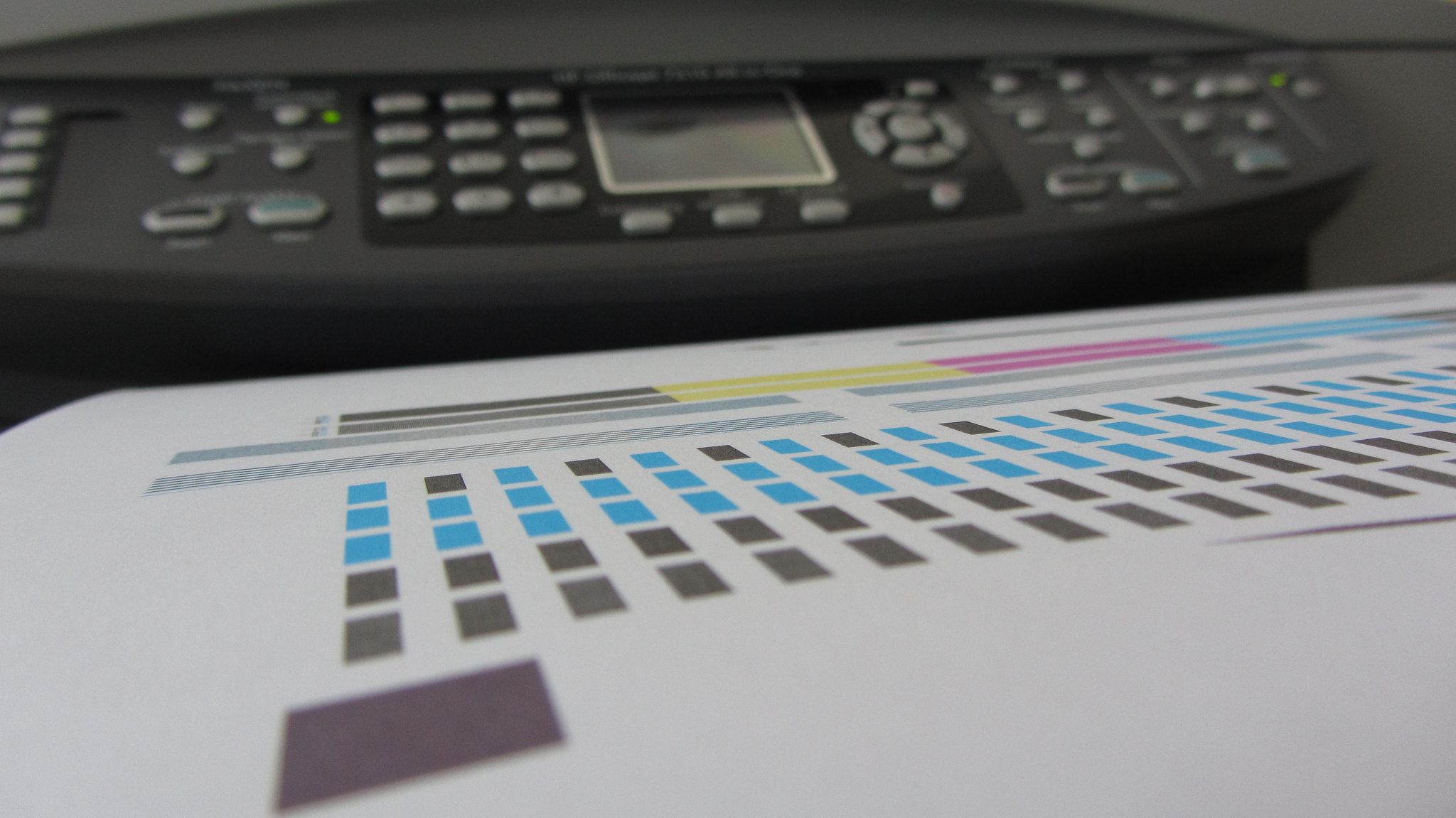
Image credit: Christiaan Colen HP 7310 Printer, CC-BY-SA via Flickr
-
Davis, J.L., 2020. How artifacts afford: The power and politics of everyday things. MIT Press. ↩︎
-
Verbeek, P.-P., 2006. Materializing morality: Design ethics and technological mediation. Science, Technology, & Human Values 31, 361–380. https://doi.org/10.1177/0162243905285847 ↩︎
-
Wachter-Boettcher, S., 2017. Technically wrong: Sexist apps, biased algorithms, and other threats of toxic tech. WW Norton & Company. ↩︎
Replies
Join the conversation by replying to this post on Mastodon. Public replies show here.
On a different Mastodon server? Paste https://aus.social/@KathyReid/112017405284417827 into your server's search to reply from there.