In my 27 years of professional life, I’ve attended, organised, and even keynoted - several conferences. Moreover, having spent time working in the audio-visual and videoconferencing service management space at a university, I’m uniquely qualified to have some (informed) opinions about the need for universities to have an integrated academic conference service offering. I’ve been thinking about this problem for the last few years, however, as the Publicity Chair for the Australasian Language Technology Association’s Workshop - ALTA 2024, the experience has been a microcosm of the broader issue of academic conferencing - and I wanted to get my thoughts onto virtual paper.
What is an academic conference, and what makes it different to other types of conferences?
Here begins a brief typology of conferences.
- Hobbyist or community driven conferences - if you’ve ever been to an Everything Open or a DrupalSouth or a WordCamp or to something like a Perl or Rust conference, chances are it’s been volunteer organised by passionate members of a community. Sure, it comes with large costs like a venue, catering, conference dinners and so on - and needs decent sponsorship to run at-cost, but it’s run by hobbyists. I don’t say amateurs, because many of the community conferences I’ve been to have been better organised than commercial conferences. These sorts of conferences are often auspiced by a peak body or foundation, which provides a legal structure for things like insurance and financials. For example, Everything Open, DrupalSouth and WordCamp are all auspiced by Linux Australia. Profits from the conference - if there are any - generally go to supporting the community the conference is for (and by). Ticket prices for these conferences are generally more affordable, and vary with things like the ability of the organisers to attract sponsorship. Organisation of the conference tends to move around the community - it will be in one city in one year, then move to a different city the next, with a new team every year.
- Conferences with professional event management or audio visual or other professionally delivered services - sometimes a community driven conference will hire professional services for a portion of the event. This might be hiring a professional event manager, paying for professional audio visual services from the venue or a third party, and having catering supplied. The amount of professional services brought in will vary with the conference’s complexity and budget.
- Commercial conferences - here, the conference is a commercial venture, designed to generate a return on investment - whether that’s monetary or in the form of brand exposure and marketing leads. If you’ve been to something like PAX, or where the tickets were $AUD 2500 for two days, then you’re at a commercial conference. The sponsors generally buy speaking time, or “present” various areas of the conference. Companies who run large conferences will often have a dedicated conferencing team who run the conference - or suite of conferences - on an ongoing basis. Most of the Quest Events conferences - such as the Women in Technology Summit or the Generative AI summit fall into this category.
| Conference aspect | Hobbyist / Community | Professional services | Commercial |
| Business model | Ticket price plus sponsorship yields cost recovery or modest profit | Ticket price plus sponsorship yields cost recovery or modest profit. Revenue must cover professional services costs. | If profit is the motive, ticket price plus sponsorship yields profit. If brand exposure is the motive, company may absorb some or all costs. The conference becomes a loss leader for sales leads. |
| Budget | low | mid-range | high |
| Ticket price | low | mid-range | high |
| Sponsorship needed | low | mid-range | depends on the business model |
| Speakers | Usually via an open, merit-based Call for Papers / Call for Proposals process. CfPs often assessed via a Selection Committee. Keynotes usually by invitation. Speakers usually given a free ticket; Keynotes may be comped accommodation and travel, possibly a stipend. |
Speakers are often invited from large organisations. Invitation process often opaque, with a leaning towards high profile Speakers to draw in attendees. In lieu of payment, the Speaker's organisation is usually comped several tickets to the conference. |
|
| International attendees | Dependent on the size of the conference and how it is viewed overseas | Often will have international delegates. | |
| Venue | Variable based on budget of conference. | Generally if the conference has enough budget for professional services, it will be held at a convention centre. | Usually professional conference or convention centre. |
| Format | In person, but increasingly hybrid in the wake of COVID[^1] [^2] | Dependent on if professional AV services have been engaged. | Predominantly in person, hybrid availability depending on skills within conference organising committee. |
| Proceedings or artefacts from the conference | Videos from talks may be recorded and made available on platforms such as YouTube. | Dependent on if professional AV services have been engaged. | Videos or slides are often made available through an attendee-only portal. |
| Auspice or governing organisation | Community organisation or foundation | Commercial company; may run multiple conferences if conferences are the revenue generation mechanism. | |
An academic conference generally follows a community conference format, with the following distinctions:
- The auspicing body is usually a learned society or academic association. Some of the societies and academic associations that auspice several conferences include the Association for Computing Machinery (ACM) - which runs conferences like FAccT and EEAMO - and the Institute of Electrical and Electronic Engineers (IEEE) - which runs several computing-related conferences.
- Like a community conference, the organising team generally rotates across institutions and locations.
- However, the people organising the conference are usually academics who practice in the field that the community is about. This is, they are hobbyist conference organisers. They may have a lot of experience, or may not. But conference organising is not their core competency (even though they may be very competent in it).
- Academic conferences often have additional requirements to community conferences to meet academic standards. These include:
- Peer review of papers submitted to the CfP (often requiring 3-4 reviews per paper by people familiar with the discipline)
- Production of a Conference Proceedings, using publishing tools like LaTeX, using platforms like OpenReview or EasyChair
- Submission of proceedings to academic indices such as Scopus or to a proceedings anthology site (like ACL Anthology).
That is, academic conferences have all the requirements of non-academic conferences - venue booking, catering, social event management, schedule creation and tracking, speaker liaison, audio visual management (especially in an era of Zoom and hybrid), promotion of the event via media and public relations channels, delegate visa issues, accommodation and travel - and they have additional academic requirements like conference proceedings.
Why is an integrated academic conference service needed?
So, what’s the problem here?
Running conferences is part of a broader literature on academic workloads. I’m not going to litigate that material here, other than to say that over the past two decades, a more managerial approach to governing universities has resulted in the creation of workload models that try to capture the breadth of activities academics perform, and link them to KPIs used for academic promotion - such as the number and quality of research outputs and the load and quality of teaching1.
However, from what I can tell, running conferences - as opposed to presenting at conferences - does not form part of mainstream academic workload models (but to be fair I haven’t conducted a thorough analysis - but it doesn’t show up in a cursory search of academic workload models).
For academics, running conferences is, in general, a non-promoteable activity. It doesn’t “count”. But without this activity, the conferences that academics need to present at in order to be promoted don’t happen. It’s paradoxical. Academics need conferences, but running conferences is not seen as a valuable activity for academics to undertake (because if it was, it would count toward promotion).
Running conferences takes academics away from their teaching and research activities. The activities that count towards KPIs and to promotion. Sure, aspects like reviewing submitted papers, or presenting research is directly aligned with academic KPIs, but running conferences is not.
So, there are two choices here. Either running conferences needs to count toward promotion, or running conferences - at least the non-academic aspects - needs to be moved to a non-academic function. Here, I’m arguing for the latter case - we need a dedicated, integrated service within universities for academic conferencing so academics can spend more time producing research outputs to be presented at conferences.
What would an integrated academic conferencing service look like?
Putting together a conference requires many disparate activities, and they “sit” in different places in universities.
- Room bookings: Some universities have conference centres or equivalent facilities, and space is managed differently at different institutions. But what is common is that room bookings are generally spread over three or more systems, with varying business rules around who can book what space when. This is an administrative task, that requires internal systems knowledge of the university. If the conference venue is off-campus, facilities bookings still need to be made
- Audio visual: A great conference requires great audio visual facilities - and the expertise to use them well. Even on the same university campus, different rooms have different equipment, and you need local knowledge to use them well. Moreover, AV support is needed during conferences - people now bring their own laptops. AV sometimes sits in the IT function, sometimes in a facilities function. And having AV people available in person is now a harder ask, as much AV equipment is now configured to be remotely monitored - IT service delivery is set up to only send people - “boots on the ground” - when a failure occurs, not to help set up equipment. But you need AV-savvy support during a conference, particularly if it’s running in hybrid mode.
- Event management: There are many activities involved in event management such as catering, security, VIP protocols if VIPs are in attendance, Welcome to Country ceremonies, car parking, logistics, registration and name tags - and they are primarily administrative and public relations functions. In universities, Event Management is often a central Marketing function, but is usually tasked with major university events like graduation and open days.
- Website: Each conference needs a new website every year, which contains information. Most conferences also require some form of registration, which might be provided by the Auspicing organisation, or via an external site like EventBrite or Humanitix. Each conference tends to use a different website setup - WordPress, Jekyll, Squarespace and so on. Within a university, the website content editing function is either centralised within Marketing, or devolved across organisational areas. However, universities tend to use enterprise CMSs, and conferences don’t. So it usually falls to a conference volunteer to wrangle the website (and its analytics, and integrations and so on).
- Publicity: Conferences need publicity to get people to submit to the CfP process, and to get people to register to attend. Many conferences will have an announcements mailing list or similar, and will have one or more social media properties. But someone needs to manage these - producing content not just for announcements, but surfacing content from previous conferences to grow awareness of the conference. This activity is even harder these days as the social media landscape has fragmented.
- Conference proceedings: Academic conference submissions are generally done through a platform, which generally uses LaTeX and a LaTeX template. The proceedings are then usually published, again through a platform. This often falls to a team member, when it’s largely an administrative duty - albeit one requiring some knowledge of the platforms, and LaTeX.
- Sponsorship: Garnering sponsorship for a conference is tough - and it’s harder to wrangle smaller amounts from many companies. It’s much easier to have fewer sponsors, of larger amounts. But this requires long-term relationships, and trust that sponsors will get value from their sponsorship - which is built up over time. In a university, generally the only people who deal with sponsorships are Advancement or Giving departments - and then generally it’s from a philanthropy or giving perspective.
Good academic conferences need all these functions working together in an integrated way.
How would this work in practice?
The way I see this working is that a full-time team is formed with the above skills, and the team provides services to conference leads - usually senior academics in faculties and schools. The conference lead acts as the client or in a project management sense, the Project Sponsor.
Conferences don’t run all year round - they are clustered in university holidays if the conference society or auspice is in Australia, but for auspicing organisations based in the United States, they tend to run in the American summer (June to August). Having a dedicated team means the conference prep could happen in the downtime before the actual conference happening. If there are not enough conferences being run in the university to keep a full time team engaged, then the team’s skills could be used to assist faculty and school events - which require many of the same skill sets - in particular things like audio visual.
There are going to be peak periods of operation for an integrated, dedicated team - and this is where I see casuals - often university students - having a key role to play. For example, media or journalism students could be engaged to do conference PR and social media, and project management students would be able to assist with conference organisation - there’s even an opportunity here for Work Integrated Learning.
There would need to be key criteria for the integrated team to take on a conference - because they have to be funded, and they have to be able to manage demand. Some of the criteria I see here would be the international profile of the conference, or perhaps its academic ranking. Having a FAccT or a CHI conference at your campus brings huge kudos to the university.
In terms of funding, I see a core team of 2-3 people - project management, audio visual and web/media - being able to prove the viability of the model. Back of the envelope, that’s about $AUD350k for 3-ish salaries plus on-costs. The challenge is being able to prove RoI for that $350k / year - how does the university get a return on that investment? KPIs that I see as useful here would be the increased presence on campus during “down” periods (which means that campus food outlets are more frequented), increased research collaborations, and increased opportunities for university students to attend, and be involved, in conferences.
But all of these are second or third order impacts of an integrated conference team. In Richard Rumelt’s book Good Strategy/Bad Strategy2, he talks of hierarchies of objectives, and by setting a proximate objective, or guiding objective, lower level details will be taking care of. The proximate objective I see for an integrated conferencing service is “making the university the premier destination for academic conferences in Australia and the world”.
What are the risks, benefits and barriers over the current state of affairs?
Having a team with all of the above skills, full time, in a university would provide several benefits over ad-hoc teams forming for each conference.
- Firstly, it helps to make the staff time and effort spent on conferences much more transparent. Currently, a lot of conference work is distributed across schools and faculties. By bringing this work to a dedicated team, it makes the workload of conferencing more transparent.
- Secondly, by having a dedicated team, there is more scope for pooling resources for things like hybrid conferencing solutions. Zoom is great, but it’s not designed for hybrid conferences - when platforms like Venueless and Streamyard and others offer a better experience. Individually they’re expensive - and cumbersome to learn. By having a dedicated team that can deliver an excellent hybrid conferencing solution repeatedly, great solutions can be identified, tested - and replicated.
- From a content perspective, instead of having multiple staff create similar web content, a library of conference content for the university - travel, accommodation, sightseeing - could be produced that becomes “copy and paste”-able - and which also helps to showcase the university itself.
- A dedicated conferencing team would be better able to negotiate commercial arrangements with suppliers such as caterers and accommodation providers - because they could negotiate over a portfolio of conferences rather than a single conference.
There are also risks and barriers to this proposal:
- The business case is flakey - because the benefits are not immediately realisable (they take three or four steps on an investment logic map - they are indirect).
- Integrated teams that have skills from multiple areas - IT, facilities, Marketing - are always ripe for organisational empire building. These areas are not going to agree to having funding going to an integrated team, and will instead argue “those FTE roles should sit in my department and we will provide the service through our existing service management framework”. But what this means in reality for conference leads - often senior academics - is that they have to deal with three or four departments to get an outcome - that is, the academic has to do the co-ordinating work. The work they should be doing is the disciplinary work - the reviewing of submissions, setting a conference theme, facilitating research collaborations.
Parting thoughts
This isn’t a complete proposal - but it’s a start.
What are your thoughts? Is this service needed? Is it missing anything? How could it be made to work better?
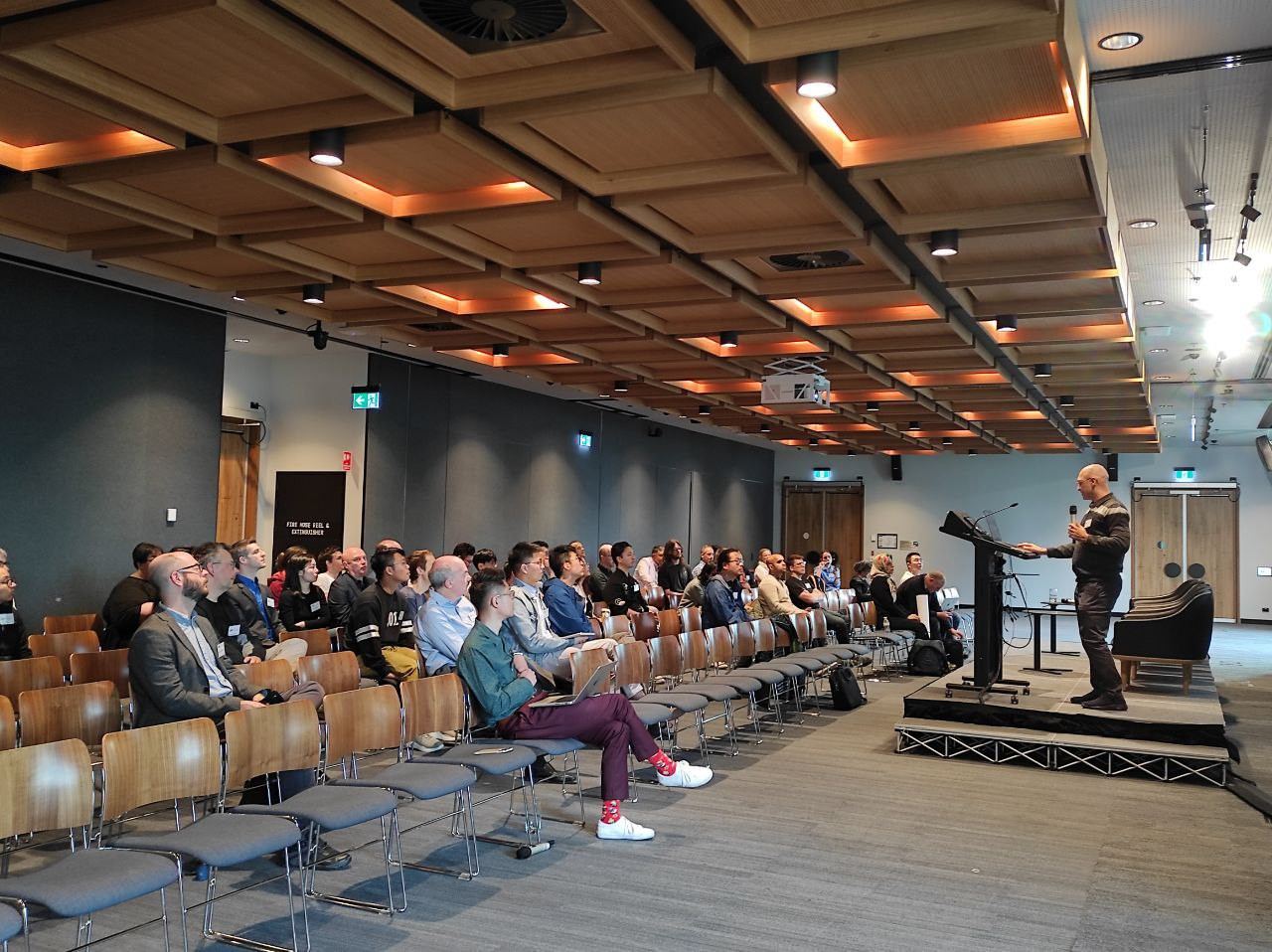
Image: Reza Haffari keynoting #ALTA2023 in Melbourne, November 2023 via the conference’s Twitter channel @altanlp