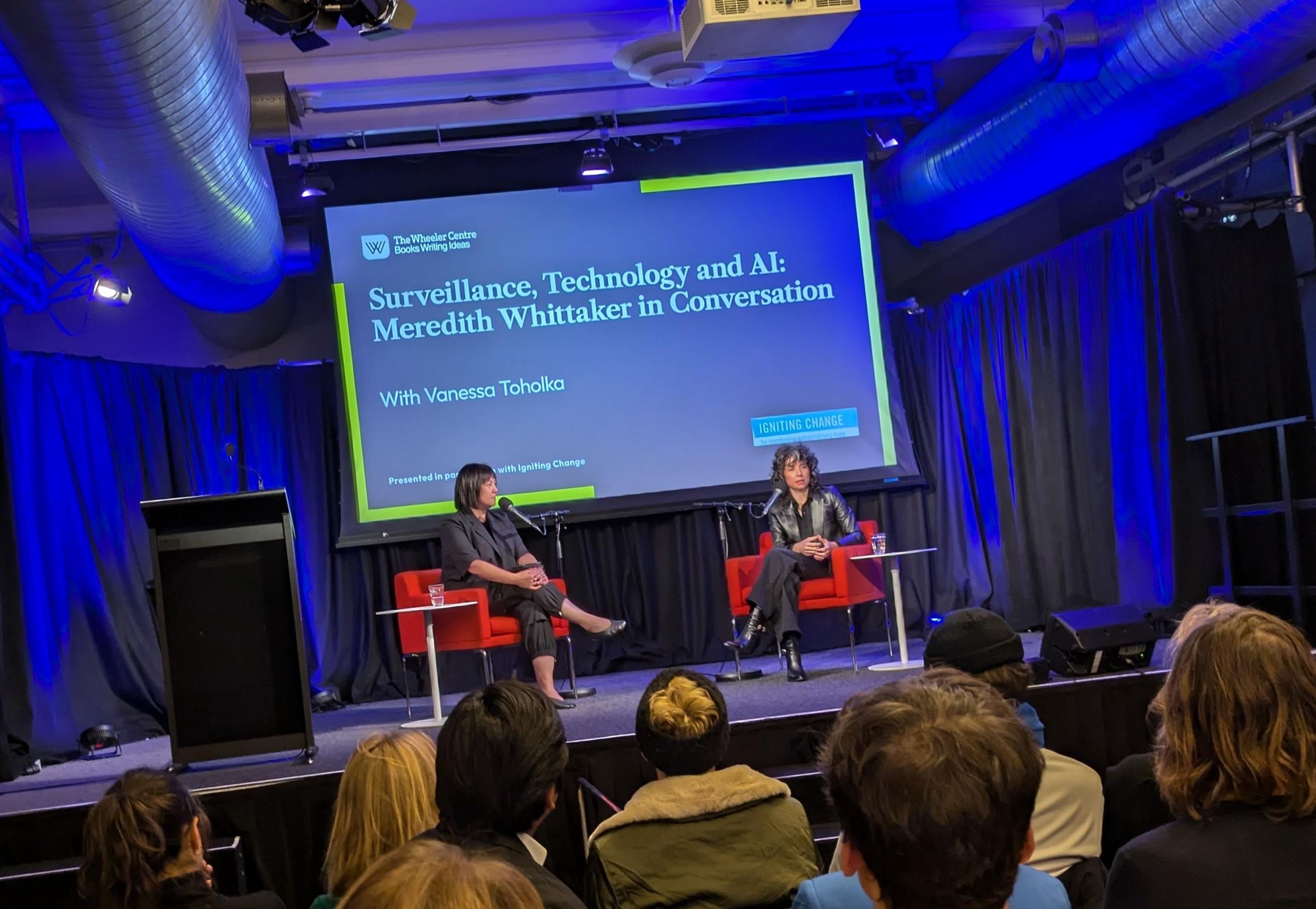
Digging where she stands - Meredith Whittaker in conversation with Vanessa Toholka at the Wheeler Centre, Melbourne
- Published
- Filed under
- Activism, Research, Technology
- Reading time
- 4 min
One of the things I miss about being physically based in Canberra is the plethora of world-class academics, policy-makers and thinkers that coalesce there. Every week, you could listen to an expert pose a provocation, advocate for a course of action or bring together unexplored inter-disciplinary threads. As someone based in a regional city, over an hour away from Melbourne, albeit one recognised as a UNESCO Creative City of Design, that privilege was never lost on me. And so, when I found out, via Mastodon, that Signal Foundation President, PhD Candidate and activist Meredith Whittaker was speaking at the Wheeler Centre, co-hosted by the charity Igniting Change, I knew she was a must-see.
Facilitator Vanessa Toholka first prompted Meredith to explore how we got here - to a world of surveillance capitalism where data about us is used as a form of capital, allowing a concentration of power in big tech companies (Shoshana Zuboff and Jathan Sadowski were never mentioned by name, but their works on surveillance capitalism and datafication were palpable in the discussion). Here, she drew on neo-liberal history at the start of the tech boom in the 1990s, showing how permissible the regulatory environment was for organisations at the time - there were few constraints on how they could approach data capture. This led to an ecosystem where there were essentially two options for revenue generation: one for infrastructure - where revenues were generated by providing carriage of data, carriage of electricity or provision of storage; and one for advertising - where revenues were generated by micro-targeting cohorts and delivering ads to them. Even today, there is little room for alternative business models. Reflecting on this, I couldn’t help but be struck by Mozilla’s recent move into advertising, which seems deeply at odds with its ethos. All paths, it seems, lead to advertising.
Following on from this, Whittaker unpacked the etymology of AI, and how the term arose as a way to distance the work of John McCarthy - its coiner - from that of Norbert Wiener and his preferred term of cybernetics. This reminded me of the work of Thomas Rid’s book The Lost History of Cybernetics - which explicates the tension between east-coast and west-coast technological developments of the 1940s to the 1990s1. She recalled the pivotal moment in 2012 when AlexNet was created - the fore-runner of ImageNet, which harnessed decades-old convolutional neural network technology - made possible by the availability of large-scale data2, and noted how many AI practitioners, such as Yann LeCun, had gone to work for Big Tech - such as Meta or DeepMind.
The discussion turned to the imbrication of power and technology, and Whittaker drew on the work of authors such as David L. Crane and his book Making the Movement: How Activists Fought for Civil Rights with Buttons, Flyers, Pins, and Posters, and the work of Canadian activist Ursula Franklin - author of the Real World of Technology, in which she shows how science interacts with society and democracy - very much in the STS space.
One of the most resonant points Whittaker made here was around how privilege operates within activism. She is well-known for helping to organise - she explicitly eschewed the term “leader” - the Google Walkouts in 2018. She quoted the phrase “dig where you stand” - a social movement in the Nordics in the 1970s promoting public participation in labour history - and which has at its core a greater appreciation for the lived experience of the working class. Here, she advocated that we have to be aware of our privilege - and act in a way that protects people of less privilege. For example, there were many H1-B visa holders at Google in 2018. They couldn’t walk out, because they would have been risking their right to residency in the United States.
So “digging where you stand” is about appreciating the privilege and positionality you have in a context, and doing what you are able to to change or resist the status quo. Reflecting on this, as a technologist, I hold a great deal of privilege in the technologies I am able to use, because of my profession and education. I can run a PiHole and a uBlock and a Flipper Zero. And I can educate others about how to use these technologies to resist surveillance and data/capta capture.That is, there is a moral obligation upon technologists - even if companies such as Google choose to remove imperatives such as “do no evil” from their constitutions.
This was under-scored by a discussion on “surgical strikes” - in which drone technologies choose targets based on “data signatures” - patterns of behaviour that are associated with a profile of a particular target. These targets are stochastic, non-deterministic. And if you don’t have enough targets, you can just “lower the confidence score” to acquire more.
The audience, quite rightly, were aghast at this.
Where I thought this conversation might go - but didn’t - was into the area of encryption, particularly given the recent debate of a “Chat Control” law in the European Union, which would allow scanning of chat apps - like Signal, WhatsApp and others - ostensibly to detect CSAM.
Whittaker is deeply opposed to laws such as these which seek to weaken end to end encryption:
Either end-to-end encryption protects everyone, and enshrines security and privacy, or it’s broken for everyone. And breaking end-to-end encryption, particularly at such a geopolitically volatile time, is a disastrous proposition.
New Branding, Same Scanning: “Upload Moderation” Undermines End-to-End Encryption
A statement from Meredith Whittaker, Signal President, in the context of the EU debate
June 17th 2024
Regardless, the evening’s conversation was deeply engaging, provocative and well-informed.
Brava, Meredith and Vanessa.